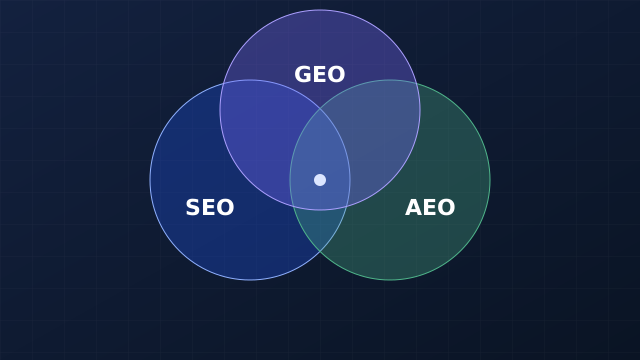
SEO (search engine optimisation) helps your pages get found and ranked in search results. AEO (answer engine optimisation) shapes content so a search engine or assistant can lift a direct answer from it. GEO (generative engine optimisation) makes your business clear and credible enough for AI tools to name and cite. They are not three strategies: AEO and GEO are SEO applied to new answer formats.
- SEO gets you listed, AEO gets you extracted, GEO gets you named and cited.
- Google says there are no extra requirements to appear in AI Overviews or AI Mode beyond normal SEO best practice.
- Start with the technical foundation, then answers, then your business identity. Skip a layer and the ones above it weaken.
SEO, AEO and GEO at a glance
The three terms describe where your content appears and what form it takes there. The underlying work overlaps far more than the acronyms suggest.
| SEO | AEO | GEO | |
|---|---|---|---|
| Goal | Rank in search results | Be the extracted answer | Be named and cited in AI answers |
| Where it shows | Google and Bing results | Featured snippets, voice answers, quick answers | AI Overviews, AI Mode, ChatGPT, Perplexity, Gemini |
| What it needs | Crawlable, indexable, relevant, useful pages | Question headings with direct, self-contained answers | Clear business identity, specific facts, corroboration |
| How you measure it | Impressions, clicks, positions | Which passages appear as answers | Mentions and citations (noisy; varies per run) |
| Depends on | Nothing else: it is the base | SEO | SEO and good answers |
What SEO covers: being found and ranked
Search engine optimisation is everything that helps a search engine discover, understand and show your pages to people looking for what you offer. Google describes its search as working in three stages: crawling, indexing and serving results (How Google Search works). A page that fails at any stage can't rank, however good the writing is.
The same page also makes a point that saves money: Google doesn't guarantee that it will crawl, index or show any page, and you can't pay Google to rank higher in organic results. Anyone selling a guaranteed ranking is selling something Google says doesn't exist.
In practice, SEO covers three kinds of work:
- Technical: crawl access, indexing, speed, mobile, HTTPS, clean URLs and redirects. Our technical SEO audit walks through each check.
- Content: pages that answer real questions better than the alternatives. Google’s guidance on helpful, reliable, people-first content is the clearest description of what its systems try to reward.
- Signals from elsewhere: links and mentions from other sites, reviews and a consistent business profile.
What AEO adds: answers that can be lifted
Answer engine optimisation focuses on one moment: when a search engine or assistant shows an answer instead of, or above, a list of links. Featured snippets, voice assistants and quick answers all take a short passage from a page and present it on its own.
A passage only survives being lifted out if it makes sense without the page around it. That means a heading that matches the question, the direct answer in the first sentence or two, and specifics rather than “it depends”. Here is what that looks like for a local business.
1H2: How much does it cost to unblock a drain in Leeds?
2Most drain unblocking jobs in Leeds cost £90 to £150 with Example Plumbing, including the call-out. 3Jobs that need a camera survey or excavation are quoted separately before any work starts. 4Prices checked October 2026.
- Question heading. Matches how people actually ask, so the passage is easy to match to the query.
- Direct answer first. Names the business, place and a price range, so it still makes sense when quoted alone.
- The one nuance that matters. Says what changes the answer, without hedging the whole thing.
- Freshness. A date tells readers (and systems) the figure was checked recently.
None of this is a trick. It is good writing for a reader in a hurry, which is why it also tends to work for search.
What GEO adds: being named and cited by AI
Generative engine optimisation is about AI-generated answers: Google’s AI Overviews and AI Mode, and assistants such as ChatGPT, Perplexity and Gemini. These tools write a new answer, often with links to the sources they used. GEO asks a simple question: when an assistant answers a question about your field, is your business clear and credible enough to be named?
For Google, the answer is explicit. Its documentation on AI features and your website says SEO best practices remain relevant and that there are no additional requirements or special optimisations needed to appear in AI Overviews or AI Mode. To be shown as a supporting link, a page must be indexed and eligible to appear in Google Search with a snippet. In practice, that means fixing crawlability and content quality before chasing any “AI optimisation” tips.
The same page explains that both features may use “query fan-out”: running several related searches across subtopics to build one response. A site that covers a topic properly, with separate, well-linked pages for its sub-questions, gives those searches more to find. The page-by-page checklist for getting cited in AI answers turns this into steps, and Google AI Overviews and AI Mode: how to control them and report on them covers the controls.
Other assistants run their own crawlers and indexes, so GEO adds a few things beyond Google:
- Crawler access: decide which AI crawlers may fetch your site. Blocking a search crawler can remove you from that assistant’s answers. See AI crawlers and robots.txt for which bots do what.
- Entity clarity: the same business name, address, phone, services and areas on your site, in your structured data and on your profiles elsewhere.
- Corroboration: independent sources (directories, reviews, press, associations) that say the same things about you.
- Content in the HTML: key facts present in the page source, not only after JavaScript runs.
Why they’re one strategy, not three
The diagram at the top shows the relationship: a technical foundation, helpful content on top of it, and three surfaces that draw on the same pages. Most of the work is shared. A fast, crawlable page with a clear answer and a well-described business serves a search ranking, a featured snippet and an AI citation at once.
Treating them as separate projects causes two common, expensive mistakes:
- Paying for “GEO” before fixing basics. If a key page isn’t indexed, no AI feature in Google Search can use it as a supporting link.
- Producing pages for machines. Mass-produced pages written to catch AI answers can fall under Google’s spam policies on scaled content abuse. Google’s guidance on AI-generated content is clear that using AI to write isn’t the problem; producing lots of pages that add little value is.
- Money: one budget, not three. Spend it on the foundation first; it pays off on every surface.
- Time: rewriting your 10 most important pages with clear answers usually beats publishing 50 new thin ones. That is our recommendation, not a Google rule.
- Risk: be wary of anyone selling guaranteed AI citations or rankings. Google says it guarantees neither, and no one else can either.
Decide where to start
Work down this list and stop at the first “no”. That is your starting point.
- Are your important pages indexed in Google? If no, run a technical audit first.
- Do those pages load quickly and work on a phone? If no, fix speed and mobile next (see Core Web Vitals explained).
- Does each key page answer its main question in the first two sentences? If no, rewrite the openings.
- Is your business name, address, phone and service list identical everywhere? If no, make it consistent and add structured data.
- Can the AI crawlers you want reach your site? If no, update robots.txt.
- All yes? Move on to improving your Google rankings page by page.
How to measure each layer
SEO is the easiest to measure. Google Search Console shows impressions, clicks and average position for each page and query. Google’s AI features page explains that AI Overviews and AI Mode traffic is counted in Search Console’s Performance report, and since 2026 a dedicated Generative AI performance report shows impressions in those features. Google AI Overviews and AI Mode: how to control them and report on them explains both.
AEO is measured by which of your passages appear as answers for your target questions. Check manually for a short list of important queries and note the date: answers change.
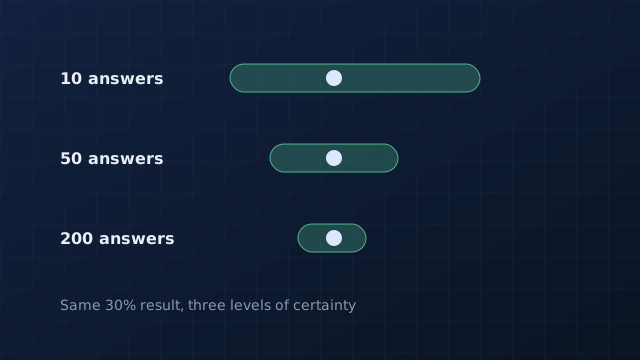
GEO is the noisiest. The same question can produce a different answer each time, so a single check proves little. We recommend tracking two things separately: a readiness score that changes only when your site changes, and occasional, repeated checks of whether assistants mention you. Mentions, citations and recommendations in AI answers explains how to count each one separately, and how to run an AI visibility audit gives the full method, including how many answers you need before a rate means anything.
Your next step
Pick your three most important pages and run them through the decision path above. If you’d rather see the answers for your whole site at once, a free 2-week AIRankSurge beta covers the technical foundation, answer readiness and AI crawler access together, and lists what to fix first.
Sources and methodology
- Google Search Central, AI features and your website: no additional requirements for AI Overviews or AI Mode, eligibility for supporting links, query fan-out, Search Console reporting.
- Google Search Central, How Google Search works: crawling, indexing and serving; no guarantee of crawling or ranking; no paying to rank.
- Google Search Central, Creating helpful, reliable, people-first content: what content quality means.
- Google Search Central, Spam policies and guidance on using generative AI content: scaled content abuse.
Methodology. This guide is based on the Google documentation above, read and checked on 28 October 2026. We have not run a controlled study for it. The plumbing example is invented to show structure. Recommendations marked as ours are opinion, not Google policy.
Reviewed .